Cable Crossover
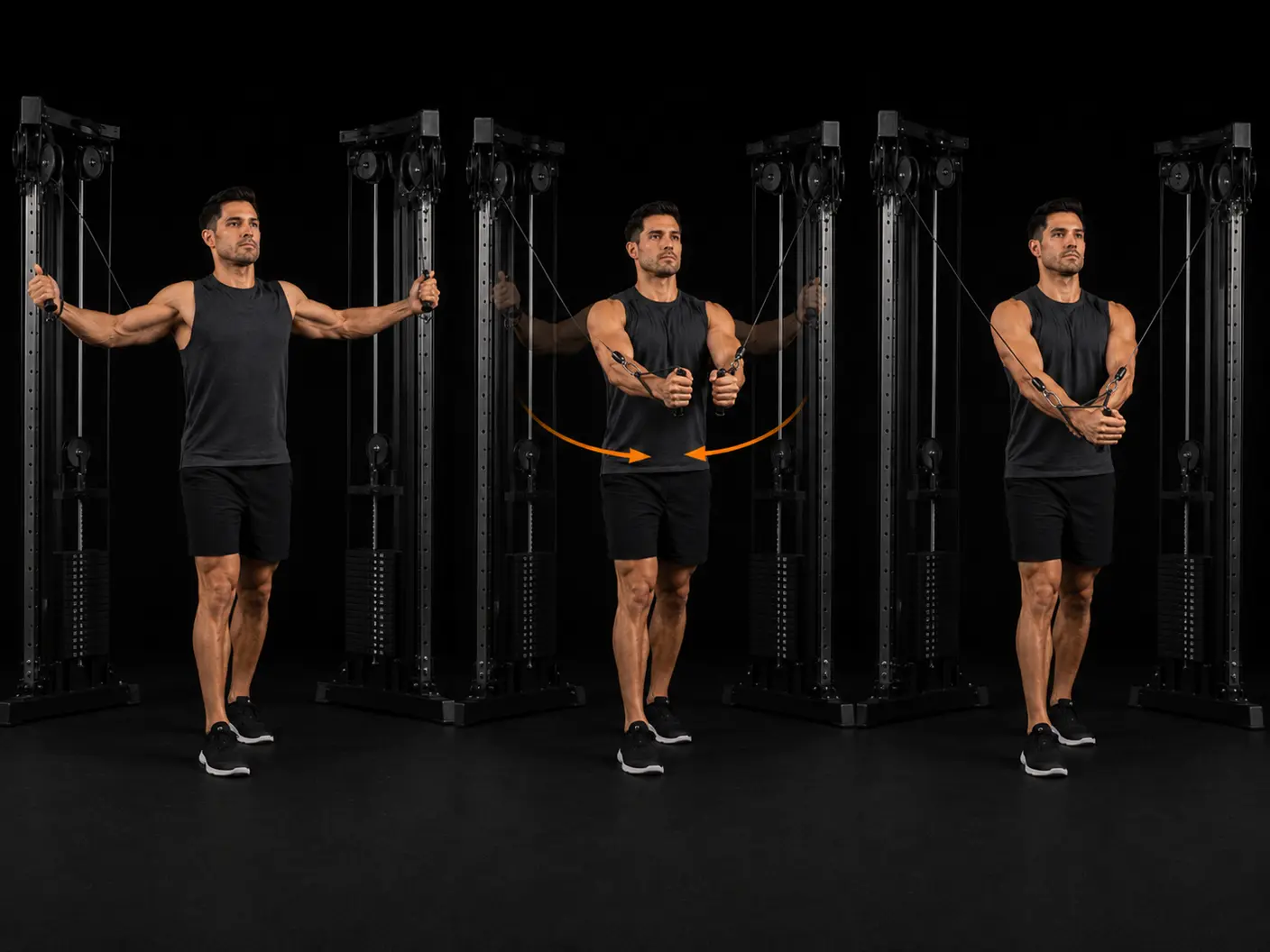
The cable crossover is a machine-based compound movement that trains the horizontal push pattern through a wide arc of motion. Using a dual cable machine set at shoulder height, it places the pectoralis major under continuous tension from full stretch through to peak contraction — a quality that free-weight pressing movements cannot fully replicate. It suits lifters at the foundational level who are building chest development within a structured hypertrophy programme.
How to do it
Set cables at shoulder height on a dual pulley. Face away from the stack, one handle in each hand, arms extended out to the sides. Step forward into a split stance. With a slight elbow bend, sweep the arms forward and down in an arc until the hands meet in front of the hips. Pause at peak contraction. Return slowly to the stretched position.
Coaching cues
- Slight elbow bend
- Hug the barrel
- Squeeze at peak
- Slow return
Why train it
- The cable resistance maintains tension throughout the entire range of motion, making it particularly effective for driving hypertrophic adaptation in the pectoralis major.
- The arc-based movement pattern allows the anterior deltoid and serratus anterior to contribute meaningfully as synergists, supporting balanced upper-body development.
- The split stance and unilateral handle grip require the body to stabilise against asymmetrical pull, reinforcing postural control alongside the primary pushing action.
- As a machine-based exercise, load is easily adjusted between sets, making it straightforward to apply progressive overload or manage fatigue within a session.
Common mistakes
- Using too much elbow bend — keep a fixed, slight bend throughout rather than turning the movement into a pressing action, which shifts stress away from the pectorals.
- Letting the torso rock forward at peak contraction — brace the trunk and hold your position so the pectoral muscles do the work rather than momentum.
- Rushing the return phase — control the handles back to the stretched position slowly, as this eccentric portion is where a significant portion of the hypertrophic stimulus is generated.
- Setting the cables too high or too low — handles should start at shoulder height so the arc finishes cleanly in front of the hips at full contraction.
Primary: Pectoralis Major.
Secondary: Anterior Deltoid, Serratus Anterior.
Equipment
Good for
Easier variation
Pec deck machine — fixed path version with less stabilisation demand.
Similar movements
Frequently asked
- What muscles does the cable crossover work?
- The primary muscle is the pectoralis major, which drives the sweeping arc of the arms. The anterior deltoid and serratus anterior act as secondary muscles, assisting with arm movement and scapular stability respectively.
- How many sets and reps should I do for the cable crossover?
- For hypertrophy, three to four sets of ten to fifteen repetitions is a well-supported range. Prioritise a controlled tempo — particularly on the return — over simply accumulating reps.
- Where does the cable crossover fit in a chest session?
- It is most commonly programmed as an accessory movement after compound pressing exercises such as the bench press. Its continuous-tension characteristic makes it useful for finishing work once heavier compound lifts have been completed.
- What are good alternatives to the cable crossover?
- The dumbbell fly trains a comparable arc pattern and is a practical substitute if a dual cable machine is unavailable. The key difference is that dumbbell flyes lose tension at the top of the movement, whereas cables maintain it throughout.
- Is the cable crossover suitable for beginners?
- It is classified as a foundational movement, so it is appropriate for those early in their training, provided they learn to control the arc rather than relying on momentum. Starting with a lighter load to establish the correct sweeping path before adding weight is advisable.
Want this movement in a plan built for you?
Adaptiv programmes the right exercises for your goal, equipment and experience — then adapts them as you train.
Build my programme