Arnold Press
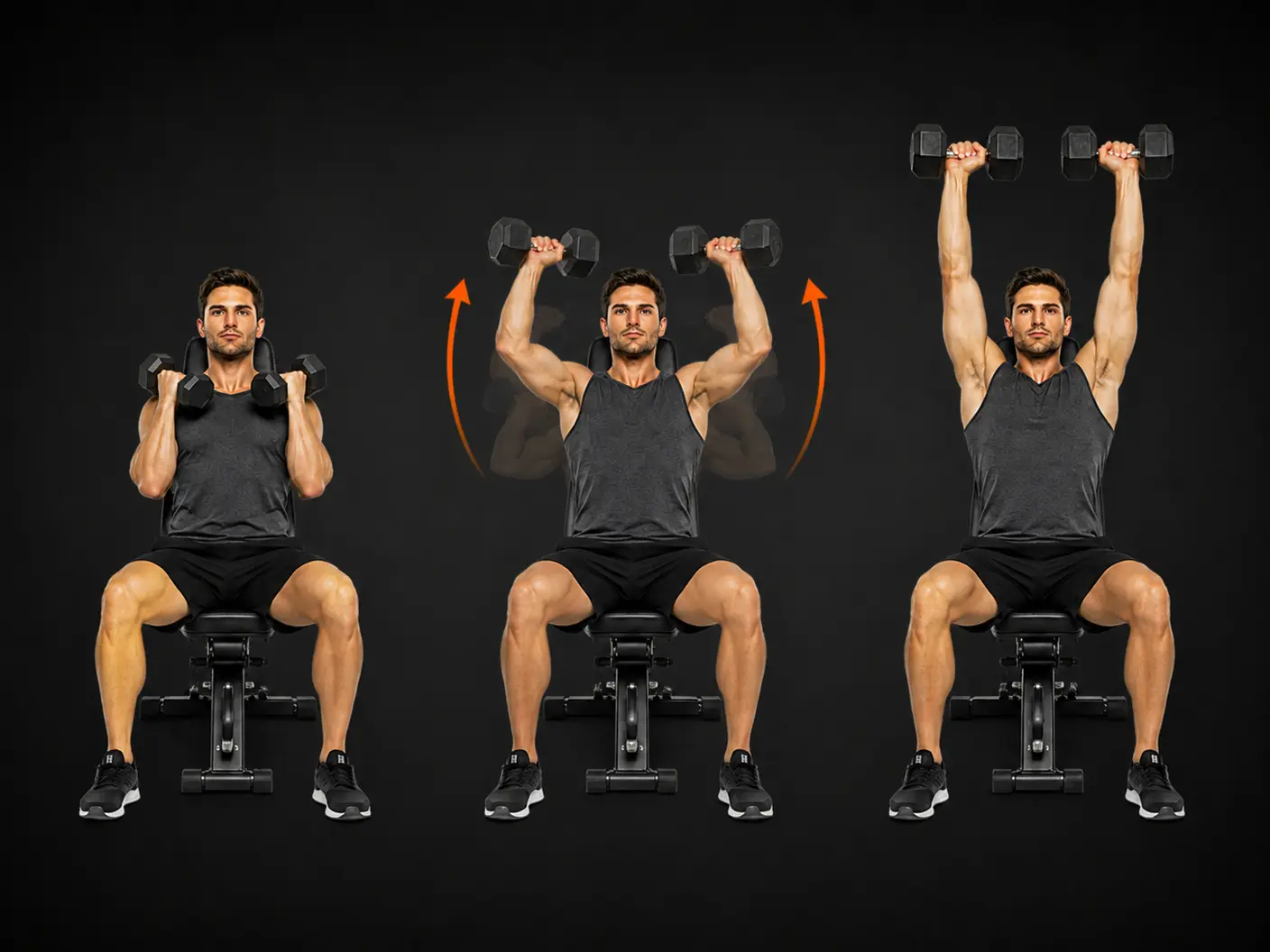
The Arnold press is a dumbbell shoulder exercise that combines a rotational element with a conventional overhead press, cycling through a greater arc of shoulder movement than a standard press allows. It trains the vertical push pattern and places particular emphasis on the anterior and medial deltoids, with supporting work from the posterior deltoid, triceps, and upper pec. It suits intermediate lifters who have a sound pressing foundation and are looking to add volume and variety to shoulder hypertrophy work.
How to do it
Sit with dumbbells held at shoulder height, palms facing toward you (like the top of a curl). Press up while rotating the dumbbells outward; palms face forward at the top. Reverse the motion to return — rotate and lower together.
Coaching cues
- Rotate as you press
- Deep stretch at the bottom
- Full range
- Control both halves
Why train it
- The rotational component means the deltoid is recruited across a longer range of motion than a fixed-grip press, making it a time-efficient option for shoulder hypertrophy work.
- Starting with palms facing inward places the anterior deltoid under load from a deep, stretched position, increasing the stimulus at the muscle's most lengthened point.
- Using dumbbells requires each shoulder to work independently, which helps identify and address left-to-right strength or coordination imbalances over time.
- The movement also draws in the triceps and upper pec as secondary contributors, making it a modestly efficient compound exercise for the upper body pushing pattern.
Common mistakes
- Rushing through the rotation — treat the rotation and the press as one continuous, controlled movement so the shoulder stays loaded throughout the full arc.
- Cutting the range short at the bottom — lower the dumbbells until you feel a genuine stretch in the shoulder before initiating the next rep, rather than bouncing out of a shallow position.
- Using momentum to initiate the press — brace through the torso and initiate the movement from the shoulder rather than rocking the torso to get the dumbbells moving.
- Allowing the elbows to flare excessively wide at the top — keep the lockout position clean and vertical rather than letting the arms drift behind the ears, which shifts stress away from the deltoids.
Primary: Anterior Deltoid, Lateral Deltoid.
Secondary: Posterior Deltoid, Triceps Brachii, Pectoralis Major.
Equipment
Good for
Easier variation
Seated DB press — removes the rotation and simplifies the pattern.
Similar movements
Frequently asked
- What muscles does the Arnold press work?
- The primary muscles are the anterior and medial deltoids. The posterior deltoid, triceps, and upper pec contribute as secondary movers throughout the press.
- How many sets and reps should I do for the Arnold press?
- For hypertrophy, three to four sets of eight to twelve reps works well, with load selected so the final two reps of each set are genuinely challenging. Rest ninety seconds to two minutes between sets to allow sufficient recovery without losing training density.
- What is the difference between an Arnold press and a standard dumbbell shoulder press?
- A standard dumbbell shoulder press typically begins and ends with a fixed grip, whereas the Arnold press adds a rotation from a palms-in start position to a palms-forward finish. This rotation increases the range through which the deltoid is under tension and places a greater stretch on the anterior deltoid at the bottom of each rep.
- Can I do the Arnold press standing?
- The movement is most commonly performed seated to remove lower-body involvement and keep focus on the shoulder, but a standing variation is possible. If you press standing, ensure you have the core stability to avoid excessive lumbar extension as the dumbbells move overhead.
- Is the Arnold press suitable for beginners?
- The movement is classed as intermediate because it requires the lifter to coordinate rotation and pressing simultaneously while controlling load through a long range of motion. Those new to overhead pressing are generally better served by a standard seated dumbbell press until they have established sound shoulder mechanics and control.
Want this movement in a plan built for you?
Adaptiv programmes the right exercises for your goal, equipment and experience — then adapts them as you train.
Build my programme