Shrug (Barbell or Dumbbell)
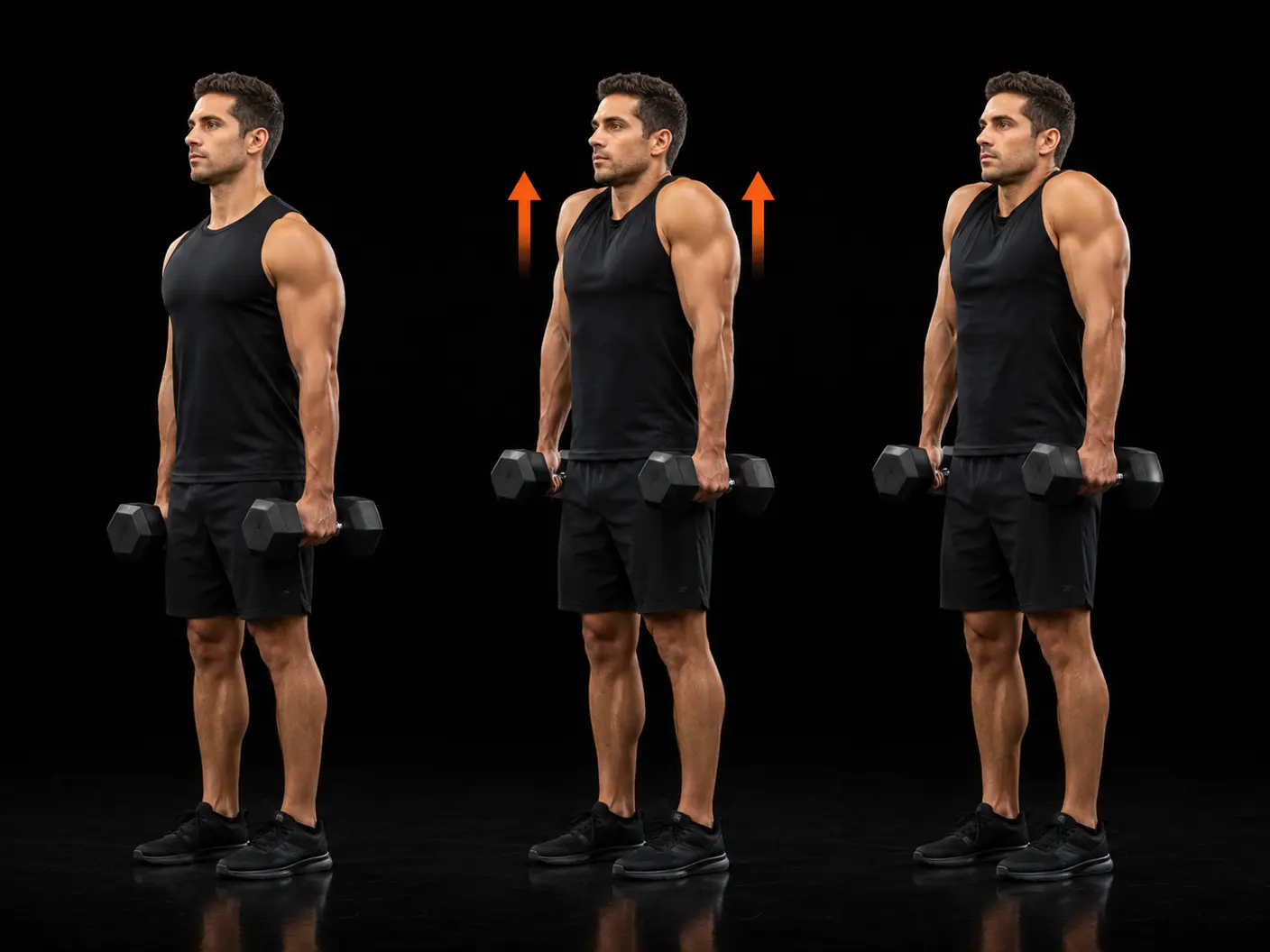
The shrug is an isolation movement that targets the upper trapezius through shoulder elevation — lifting the shoulders directly toward the ears against resistance. Performed with either a barbell held in front of the body or a dumbbell in each hand, it is one of the few exercises that directly loads this portion of the trapezius through its primary function. It suits beginners building foundational upper-back mass and more experienced lifters seeking to bring up a lagging muscle group.
How to do it
Hold a barbell or two dumbbells at the sides with straight arms. Keep the chin neutral and eyes forward. Elevate the shoulders straight up toward the ears. Pause at peak contraction. Lower under control to a full stretch.
Coaching cues
- Straight up
- Pause at the top
- No rolling
- Long neck
Why train it
- Direct loading of the upper trapezius through its primary action of shoulder elevation makes the shrug one of the most efficient ways to develop thickness across the top of the shoulders and neck.
- The foundational difficulty level means the movement can be introduced early in a training programme, allowing newer lifters to build the upper trapezius without requiring complex technique.
- Dumbbell variation allows each shoulder to move independently, which can help address side-to-side asymmetries in the upper trapezius over time.
- The controlled lowering phase stretches the upper trapezius and levator scapulae under load, supporting both hypertrophy and a fuller range of motion through the elevation pattern.
Common mistakes
- Rolling the shoulders in a circular motion — move the shoulders straight up and straight down, as rotation reduces tension on the target muscle and places unnecessary stress on the shoulder joint.
- Using excessive load that forces a shortened range of motion — select a weight that allows the shoulders to elevate fully toward the ears and return to a complete stretch at the bottom.
- Jutting the chin forward or losing neck neutrality — keep the chin level and eyes forward throughout to avoid compressing the cervical spine under load.
- Rushing through the top position — pause briefly at peak contraction before lowering, as this brief hold improves recruitment of the upper trapezius and prevents the movement from becoming entirely momentum-driven.
Primary: Trapezius.
Secondary: Rhomboids.
Equipment
Good for
Easier variation
Dumbbell shrug — easier load management than barbell.
Similar movements
Frequently asked
- What muscles do shrugs work?
- The primary muscle trained is the upper trapezius, which elevates the shoulder girdle. The levator scapulae and rhomboids are also involved as secondary muscles throughout the movement.
- How many sets and reps should I do for shrugs?
- For hypertrophy, three to four sets of ten to fifteen repetitions with controlled tempo and a pause at the top works well. If you are training for general fitness, two to three sets in the same rep range is a practical starting point.
- Barbell or dumbbell shrugs — which is better?
- Both variations train the same muscles effectively. Dumbbells allow a more natural hand position and independent movement of each shoulder, while a barbell allows heavier loading once technique is established. Either can be programmed depending on what equipment is available and which feels more comfortable.
- Should I roll my shoulders when I shrug?
- No — the movement should be straight up and straight down. Rolling the shoulders does not increase upper trapezius activation and introduces unnecessary shear forces at the shoulder joint.
- Where do shrugs fit in a training programme?
- Shrugs are typically placed at the end of an upper-body or back session, after compound pulling movements such as rows or pull-ups. They can also appear on a dedicated shoulder day as a finishing movement for the upper trapezius.
Want this movement in a plan built for you?
Adaptiv programmes the right exercises for your goal, equipment and experience — then adapts them as you train.
Build my programme