Nobody has ever been told off for skipping a cool-down, and nobody has ever felt entirely comfortable doing it.
Short answer: warm up, briefly and specifically — and don't feel obliged to cool down.
A warm-up is worth five to ten minutes because it changes how the next hour goes: warmer muscle produces force more readily, and rehearsing the movement you're about to load tells you what today's weight will feel like. A cool-down is a different proposition. What it's popularly sold as doing — clearing soreness, speeding recovery, preventing injury — is what the research has most consistently failed to find. That doesn't make it worthless. It does make it optional in a way the warm-up isn't.
The verdict in one table
| Warm-up | Cool-down | |
|---|---|---|
| Improves today's session? | Usually | n/a — it's over |
| Improves the next one? | Not its job | Largely no |
| Reduces soreness? | Not what it's for | No |
| Prevents injury? | Weak, mixed evidence | No evidence |
| Time budget | 5–10 min | 0–5 min, optional |
Behind that first row is a systematic review of 32 high-quality studies in which warming up improved performance in 79% of the outcomes examined (Fradkin et al., 2010) — a tally across many activities rather than a precise effect size, but a consistent one.
What a warm-up actually does
Three mechanisms do most of the work, and knowing them tells you where to spend the five minutes (McGowan et al., 2015).
Temperature. Heat speeds the reactions that produce force and reduces tissue resistance to movement — part of why the third set feels smoother than the first.
Metabolic readiness. Getting your breathing and circulation up beforehand means oxygen is arriving when the first round begins, rather than your muscles scrambling for it. This matters far more for conditioning than for five squats.
Rehearsal. Doing the movement under progressively heavier load primes the pattern, and a heavy-ish set can briefly leave a muscle able to produce more force. This is the part most people under-use, and the part most specific to lifting.
Does a warm-up actually improve your lifting?
Here's the part the gym consensus skips: tested specifically against resistance training, warm-ups have produced inconsistent results.
In one crossover trial, no warm-up condition beat doing nothing at all. Fifteen men took bench press, squat and arm curl to failure at 80% of their one-rep max under four conditions — no warm-up, a specific warm-up, an aerobic warm-up, and both combined — and there was no significant difference in total repetitions or in the drop-off between sets (Ribeiro et al., 2014).
It's a small study, and failing to find a difference isn't the same as showing there isn't one — but it should temper any claim that skipping a warm-up wrecks your session.
Two findings sharpen the picture. First, intensity is what costs you; duration is what buys the benefit. Sixteen strength-trained men were tested for leg press one-rep max after four general warm-ups. Fifteen minutes of easy general work improved it by around 3%; the same fifteen minutes at moderate intensity reduced it by about 4%, and five-minute versions of either were indistinguishable from no warm-up at all (Barroso et al., 2013).
Fatigue you generate in the warm-up is fatigue you don't have for the work — but note the inconvenient half: the short warm-ups didn't help either. That was a maximal single, though, where a long temperature ramp plausibly earns more than in a rep-range session — and the ramp sets below do that job.
Second, the load you finish on matters. Fifteen men with training experience warmed up at 40%, 60% or 80% of their ten-rep max — the heaviest weight they could lift ten times — for 15, 10 and 5 reps respectively, before three sets to failure. The 80% condition produced significantly greater total training volume (Viveiros et al., 2024). Heavier and shorter, note: the conditions differed in both, so read it as an argument for finishing near your working weight without piling up reps on the way.
Neither settles anything alone, but together they point somewhere useful: keep the general part genuinely easy, and spend your effort getting close to the working weight.
How long should a warm-up be, and what goes in it?
If you keep one thing from this article, keep this. For a loaded compound lift, the most useful warm-up is a few sets of the lift itself, climbing towards the working load at low reps so they cost you almost nothing — roughly 40%, 60% and 80% of your working weight, for about 5, 3 and 2 reps. For a 100 kg back squat:
| Set | Load | Reps |
|---|---|---|
| Ramp 1 | 40 kg | 5 |
| Ramp 2 | 60 kg | 3 |
| Ramp 3 | 80 kg | 2 |
| Working set | 100 kg | as prescribed |
The percentages are a shape, not arithmetic to obey. If a rung lands below the empty bar, start at the bar; if two round to the same weight, do one of them — the plate calculator will tell you what's makeable. Below roughly 20 kg there's nothing to build up to, so a light set or two is the whole warm-up.
Lifts starting from a dead stop, like the deadlift, earn an extra rung: there's no bounce out of the bottom to help the first rep.
Rest only as long as it takes to change the plates — around thirty seconds between rungs, then a full rest before the working set. The whole ramp should take three or four minutes, not ten. If the ramp itself needs recovery, it was too heavy.
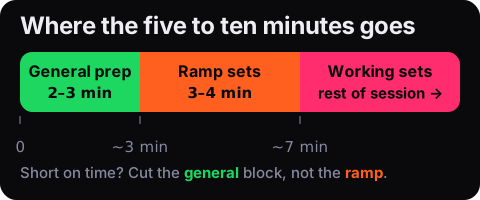
New to a lift and unsure of the working weight? Ramp by feel — the bar, a moderate jump, then a set at about half your effort — and let the first working set tell you the number. The one-rep max calculator gets you an estimate if you'd rather work from a percentage.
| Session | General part | Specific part |
|---|---|---|
| Heavy compound lift | 2–3 min, easy | 3 ramp sets to 80% |
| Accessory or isolation | none — you're warm | 1 light set |
| Conditioning | 3–5 min, breathing up | 30 s of each movement |
| Short on time | skip it | 60% and 80%, then start |
The one case for going longer is a cold garage in February — five minutes rather than two, and expect the first rung to feel heavier than the number says. How much any of this matters varies with age, training history, time of day and how your joints feel that morning: the budget is a guide, not a prescription.
Ramp sets also do double duty as information. If 80 kg moves like a brick today, you've learned something about the 100 kg before you're underneath it — so act on it. Take the working set down five to ten per cent, or hold the load and cut a set. One heavy day is noise; three in a row is a signal about sleep, food, or how much you've scheduled.
Heaviness and pain are different readings, though: a sharp or unfamiliar pain in a warm-up set is a reason to stop that movement for the day, not to ramp into it more carefully.
The common mistake: treating the warm-up as cardio. Five minutes on a bike raises your temperature but rehearses nothing and tells you nothing about today's load. So when you're short on time, cut the general part, not the ramp.
Does warming up prevent injury?
This is the claim made most often and supported least well, so it deserves a straight answer.
A systematic review of randomised controlled trials found five high-quality studies: three reported that warming up significantly reduced injury risk, two found no significant reduction. The authors concluded there was insufficient evidence to endorse or discontinue routine warm-up for injury prevention, while noting the weight of evidence favours reduced risk (Fradkin et al., 2006).
Where the evidence is strong, it points somewhere revealing. The FIFA 11+ programme — structured strength, balance and controlled landing work performed as a warm-up — cut injuries by around 39% in recreational and sub-elite footballers, while its predecessor, FIFA 11, showed no significant effect (Thorborg et al., 2017). Both sat at the same point in the session; what differed was their content. And across 25 sports-injury prevention trials including more than 26,000 participants, strength training reduced injuries to less than a third, while stretching showed no beneficial effect (Lauersen et al., 2014).
That reframes the question. What protects you is largely the training itself — getting stronger, in controlled ranges, applied consistently through progressive overload — not the act of warming beforehand. A warm-up is a good place to put some of that work, not a substitute for it, and no warm-up makes a session injury-proof.
Should you stretch before lifting?
Distinguish the two kinds, because the evidence treats them very differently.
Static stretching — holding a lengthened position — carries an acute cost that scales with how long you hold. A meta-analysis of 104 studies found pooled reductions of around 5.4% in strength and 2.0% in explosive performance, plus a 1.9% reduction in power that did not reach statistical significance, with the smallest effects at 45 seconds or less (Simic et al., 2013); a separate review put holds of 60 seconds or more at around 4.6%, against 1.1% for shorter ones (Behm et al., 2016).
Keep that in proportion. The same review found that when static stretching was followed by dynamic activity — which any sensible warm-up involves — no clear performance effect remained, and concluded that stretching within such a warm-up is reasonable for increasing range of motion (Behm et al., 2016). The rule isn't "never stretch". It's don't let long static holds be the last thing you do before a heavy set.
Dynamic stretching — moving through range under control — is the better default. A review of the current literature found it improves range of motion and tends to improve subsequent force, power, sprint and jump performance (Opplert & Babault, 2018). That same review notes plenty of studies finding no effect or a slight impairment, and that bouncier stretching is less useful than controlled movement — so keep it deliberate rather than ballistic.
Warming up for conditioning
Conditioning changes the calculation, because the metabolic mechanism becomes the main one. Start an interval or an EMOM — every minute on the minute, where each new minute begins a fresh round of work — cold, and your oxygen uptake is still climbing while the effort is already maximal. More of the first round gets paid for anaerobically, and you reach round two needlessly fatigued.
So the general part matters more here than for lifting. For a 12-minute EMOM of swings and burpees: three minutes of easy rowing to get your breathing up, thirty seconds of each movement at roughly the pace the workout will demand, then a minute or two of nothing before the clock starts. That pause matters — an active warm-up can backfire if it's too intense or leaves too little recovery, most clearly for very short efforts (Bishop, 2003).
Cool-downs: what they do, and what they don't
Now the less comfortable half. The fullest attempt to answer this — a narrative review comparing active cool-downs against simply stopping, so read it as a fair summary of a mixed literature rather than precise effect sizes — concluded they are largely ineffective for most measures of recovery, though they may offer some benefits (van Hooren & Peake, 2018). Active cool-downs:
- do not meaningfully improve same-day or next-day performance in most cases;
- do not appear to prevent injuries;
- do not significantly reduce muscle soreness, or improve recovery of muscle damage markers, how well the muscle contracts, stiffness or range of motion;
- do speed clearance of lactate from the blood — though not necessarily from muscle;
- do speed the cardiovascular and respiratory return towards baseline, and may partially blunt the temporary immune suppression that follows hard exercise;
- can interfere with the refilling of muscle fuel stores — which in practice matters mainly if you're training hard again within a few hours.
The lactate point props up most of the folklore. Lactate doesn't cause next-day soreness — it's cleared long before the soreness arrives, even if you sit down and do nothing. A cool-down does clear it from the blood faster; it just isn't clearing the thing that makes you sore.
Post-exercise stretching fares no better. The Cochrane review pooled 12 studies and found stretching before, after, or both reduced soreness by about half a point to one point on a 100-point scale — not clinically important, in the authors' words. One large field trial did find a statistically significant reduction in peak weekly soreness, but under four points on that scale (Herbert et al., 2011).
A more recent meta-analysis found no effect on strength recovery or soreness at 24, 48 or 72 hours versus resting — while noting the trials were few, mostly at high risk of bias, and confidence very low (Afonso et al., 2021). That's an absence of good evidence rather than proof of no effect.
So should you cool down?
Do it if you want to — but for the reasons that hold up, not the ones it's usually sold on.
- Don't stop dead after hard conditioning. A couple of minutes of easy movement lets your heart rate and breathing settle rather than dropping abruptly, which is simply more comfortable. Whether it prevents the light-headedness some people feel is untested — the review that examined it called that unknown (van Hooren & Peake, 2018).
- Use it as a bookend if it helps you. Some people find a few quiet minutes settles them. That needs no physiological justification.
- Do flexibility work then, if flexibility is a goal. It won't reduce tomorrow's soreness, but it's a convenient slot for range-of-motion work, when the acute cost to strength no longer matters.
What not to do is treat those five minutes as insurance. If recovery is genuinely your problem, the levers are sleep, food and how much hard work you scheduled — not the five minutes after the last set.
How Adaptiv handles this
Adaptiv builds this into the session rather than leaving it as advice. Every session opens with the same short prep note: around five minutes raising your heart rate and moving through the day's main movement patterns. It stays general on purpose, because the specific part is handled where the numbers are known.
For the main lifts, the app builds the ramp. Once your working load is set, Adaptiv computes rungs at approximately 40%, 60% and 80% of it — around 5, 3 and 2 reps — and offers them in the logger before your first working set.
Each is rounded to a weight you can genuinely make with the equipment you've told it you have, so a home gym with 2 kg dumbbells gets a ramp it can actually load, and a light lift gets a shorter one. Ramps appear only where they earn their time: loaded compound lifts above a sensible threshold — barbell, dumbbell, trap bar, cable or machine — not isolation or bodyweight work.
You can skip the ramp — it's an offer, not a gate. Warm-up sets are also recorded separately: they don't ask for an RPE rating, don't count towards your session volume, and the engine excludes them when deciding whether to add load next time. A warm-up should never make the app think you trained harder than you did.
Adaptiv doesn't prescribe a cool-down, and that's deliberate rather than an omission. On the current evidence, a scripted cool-down would be time asked of you for a benefit we couldn't honestly claim.
It's a training tool, not a medical service: it works around injuries you tell it about but can't diagnose anything, and sharp, new or persistent pain is a reason to see a qualified professional. Its ramp is a well-reasoned starting point, not a guarantee.
Adaptiv builds a resistance-training programme around your goal, equipment and schedule — then ramps you into your main loaded lifts and adjusts the working load from the reps and effort you log.
Common questions
Do I need to warm up before every exercise?
No. The first loaded compound earns a full ramp. After that you're already warm, and each new movement needs at most a lighter set or two. Isolation work at the end needs nothing.
Is it bad to skip the warm-up entirely?
It's unlikely to ruin a session — one crossover trial found no difference in repetitions to failure with or without one (Ribeiro et al., 2014) — but it's a poor default: you lose the rehearsal, and the early read on how today's load feels.
Will a cool-down stop me being sore tomorrow?
No — neither a cool-down nor post-exercise stretching meaningfully reduces delayed-onset muscle soreness. Soreness after unfamiliar or unusually hard work is normal, and fades as you repeat the exercise.
Should I stretch before or after a workout?
After, or on a separate day, if flexibility is a goal. Before lifting, prefer controlled dynamic movement through the ranges the session needs.
Key takeaways
- A warm-up is worth five to ten minutes, most of it on the lift itself rather than a bike — performance improved in 79% of the outcomes examined, a tally rather than an effect size (Fradkin et al., 2010).
- Intensity is what costs you; duration is what buys the benefit. Fifteen easy minutes improved leg press one-rep max by around 3%; the same fifteen at moderate intensity reduced it by about 4% (Barroso et al., 2013).
- Finish close to your working weight. Warming up at 80% of the session's load produced greater total training volume than 40% or 60% (Viveiros et al., 2024).
- Injury protection comes from the training, not the warming. Strength training cut sports injuries to under a third while stretching showed no effect (Lauersen et al., 2014).
- The cool-down is optional, not owed. It clears blood lactate faster and settles your breathing, but it doesn't buy you recovery (van Hooren & Peake, 2018).
- Knowing the numbers is the easy half; reading the day and adjusting session after session is the hard one — which is exactly the job Adaptiv does from the reps and effort you log. New to the vocabulary? Start with the terminology guide.
References
- Fradkin, A.J., Zazryn, T.R., & Smoliga, J.M. (2010). Effects of warming-up on physical performance: a systematic review with meta-analysis. Journal of Strength and Conditioning Research, 24(1), 140–148. https://doi.org/10.1519/JSC.0b013e3181c643a0
- McGowan, C.J., Pyne, D.B., Thompson, K.G., & Rattray, B. (2015). Warm-up strategies for sport and exercise: mechanisms and applications. Sports Medicine, 45(11), 1523–1546. https://doi.org/10.1007/s40279-015-0376-x
- Bishop, D. (2003). Warm up II: performance changes following active warm up and how to structure the warm up. Sports Medicine, 33(7), 483–498. https://doi.org/10.2165/00007256-200333070-00002
- Ribeiro, A.S., Romanzini, M., Schoenfeld, B.J., Souza, M.F., Avelar, A., & Cyrino, E.S. (2014). Effect of different warm-up procedures on the performance of resistance training exercises. Perceptual and Motor Skills, 119(1), 133–145. https://doi.org/10.2466/25.29.PMS.119c17z7
- Barroso, R., Silva-Batista, C., Tricoli, V., Roschel, H., & Ugrinowitsch, C. (2013). The effects of different intensities and durations of the general warm-up on leg press 1RM. Journal of Strength and Conditioning Research, 27(4), 1009–1013. https://doi.org/10.1519/JSC.0b013e3182606cd9
- Viveiros, L., Gioia, K., Nasser, I., Acetto, V., Farias, D., Willardson, J.M., & Miranda, H. (2024). High-load and low-volume warm-up increases performance in a resistance training session. Journal of Bodywork and Movement Therapies, 40, 1487–1491. https://doi.org/10.1016/j.jbmt.2024.08.004
- Simic, L., Sarabon, N., & Markovic, G. (2013). Does pre-exercise static stretching inhibit maximal muscular performance? A meta-analytical review. Scandinavian Journal of Medicine & Science in Sports, 23(2), 131–148. https://doi.org/10.1111/j.1600-0838.2012.01444.x
- Behm, D.G., Blazevich, A.J., Kay, A.D., & McHugh, M. (2016). Acute effects of muscle stretching on physical performance, range of motion, and injury incidence in healthy active individuals: a systematic review. Applied Physiology, Nutrition, and Metabolism, 41(1), 1–11. https://doi.org/10.1139/apnm-2015-0235
- Opplert, J., & Babault, N. (2018). Acute effects of dynamic stretching on muscle flexibility and performance: an analysis of the current literature. Sports Medicine, 48(2), 299–325. https://doi.org/10.1007/s40279-017-0797-9
- Fradkin, A.J., Gabbe, B.J., & Cameron, P.A. (2006). Does warming up prevent injury in sport? The evidence from randomised controlled trials. Journal of Science and Medicine in Sport, 9(3), 214–220. https://doi.org/10.1016/j.jsams.2006.03.026
- Thorborg, K., Krommes, K.K., Esteve, E., Clausen, M.B., Bartels, E.M., & Rathleff, M.S. (2017). Effect of specific exercise-based football injury prevention programmes on the overall injury rate in football: a systematic review and meta-analysis of the FIFA 11 and 11+ programmes. British Journal of Sports Medicine, 51(7), 562–571. https://doi.org/10.1136/bjsports-2016-097066
- Lauersen, J.B., Bertelsen, D.M., & Andersen, L.B. (2014). The effectiveness of exercise interventions to prevent sports injuries: a systematic review and meta-analysis of randomised controlled trials. British Journal of Sports Medicine, 48(11), 871–877. https://doi.org/10.1136/bjsports-2013-092538
- van Hooren, B., & Peake, J.M. (2018). Do we need a cool-down after exercise? A narrative review of the psychophysiological effects and the effects on performance, injuries and the long-term adaptive response. Sports Medicine, 48(7), 1575–1595. https://doi.org/10.1007/s40279-018-0916-2
- Herbert, R.D., de Noronha, M., & Kamper, S.J. (2011). Stretching to prevent or reduce muscle soreness after exercise. Cochrane Database of Systematic Reviews, (7), CD004577. https://doi.org/10.1002/14651858.CD004577.pub3
- Afonso, J., Clemente, F.M., Nakamura, F.Y., Morouço, P., Sarmento, H., Inman, R.A., & Ramirez-Campillo, R. (2021). The effectiveness of post-exercise stretching in short-term and delayed recovery of strength, range of motion and delayed onset muscle soreness: a systematic review and meta-analysis of randomized controlled trials. Frontiers in Physiology, 12, 677581. https://doi.org/10.3389/fphys.2021.677581